What can Chanukah teach us about tangibly experiencing G-d?
It’s incredible how perfectly Hashem works things out – down to the Jewish calendar’s cooperation with our current avodah topic!
We’ve been talking about tefillah, exploring why we find it challenging. A major theme that’s emerged? The fact that when davening, we’re trying to engage with the spiritual world – something that doesn’t actually feel real to us.
We're built to feel like reality starts and ends with the physical world – the world we perceive through our five senses. So beyond those bounds, we struggle. We know Hashem is there, listening to us pray. We know He controls everything. But we have a mighty hard time sensing it.
How can we help ourselves tangibly experience the reality of G-d?
The Chanukah story is the perfect place to turn for answers.
As the Ramban explains, Aristotle based his philosophy on the belief that reality doesn’t extend beyond the physical. If your five senses can’t tell you about it, he taught, it doesn’t exist.
We believe the opposite. We stood at Sinai, where Hashem showed our entire nation the spiritual reality beyond the physical world. A reality even more real, even more important, than its physical counterpart.
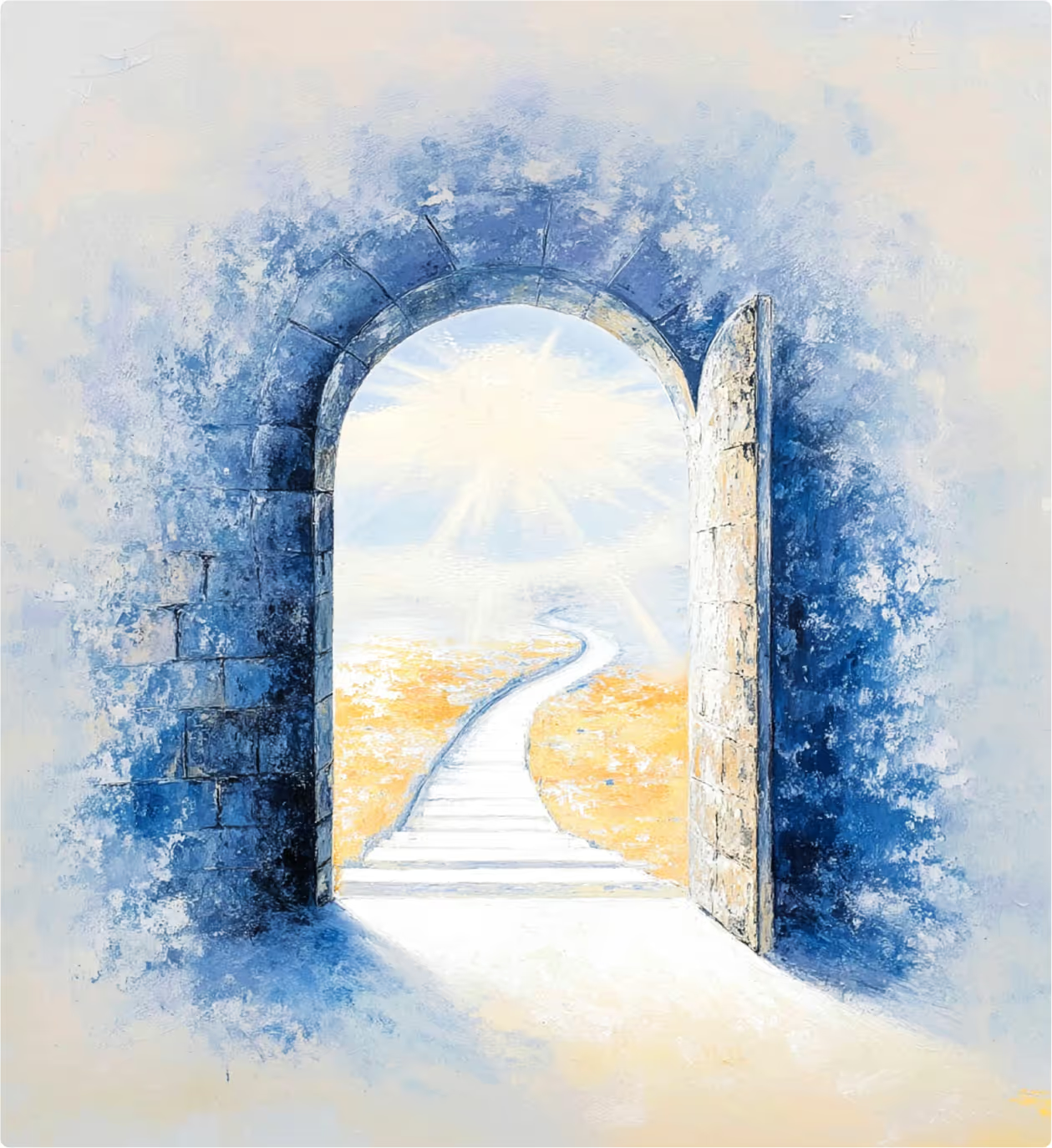
Greek philosophy tries to tie us down to this world. Torah allows us to reach up into the world Above, and connect with it.
Which is why Chanukah doesn’t come with an official sefer – unlike Purim, whose megillah was added to Tanach even though it also occurred after the first Temple’s destruction.
The message is that Chanukah symbolizes what exists Above. And like that higher reality, no official book concretizes its place in the physical world.
Chanukah contains within it the word “chinuch.” Simply translated as “education,” our Sages (Rashi ) define it more specifically as “education that sets us on a path of growth.” So Chanukah is the perfect time of year for a quest to connect to the spiritual dimension of our reality.
But how? As we mentioned, we’re naturally built to struggle with this. What can we do to move from “knowing” to “experiencing” Hashem’s reality?
Well, let’s ask another question. What’s the most natural, effortless point through which Hashem enters our world?
The point where we feel totally helpless. Where we know we’ve lost control, where there’s nothing more we can hope to accomplish on our own.
The point our heroic ancestors reached at the beginning of the Chanukah story.
It’s hard to understand how twelve Jewish priests made the decision to wage war against the world’s most powerful army. Didn’t they realize the odds were completely, ridiculously impossible?
Yes they did. They knew, perhaps with more certainty than ever before in their lives, that they were utterly helpless without Hashem. But they also knew they had to stand up for His honor. So they picked up some swords and stepped into a reality above the odds – the reality of Hashem’s complete control.
Can you remember a time in your life where you were totally at a loss? Where you looked up and thought, “Hashem, I’m stuck. I can’t do anything more. It’s all in Your hands now!”?
Of course, “it” was in His hands all along. But you weren’t experiencing that. Not when you still had those treatments to try, those contacts to reach out to, those savings to tall back on, that extra layer of physical “security.”
But once you exhausted your resources – that’s when you really, powerfully sensed Hashem’s relevance. Because there was absolutely nothing standing between you and your struggles but Him.
When you next recite Hallel or Al Hanissim, remember that time in your life. Remember that clarity. And remind yourself: the same holds true now.
Hashem is here with me. Hashem is everything. And I don’t just know it – I can experience it.
More Articles in this Series
Subscribe to the weekly list
.avif)