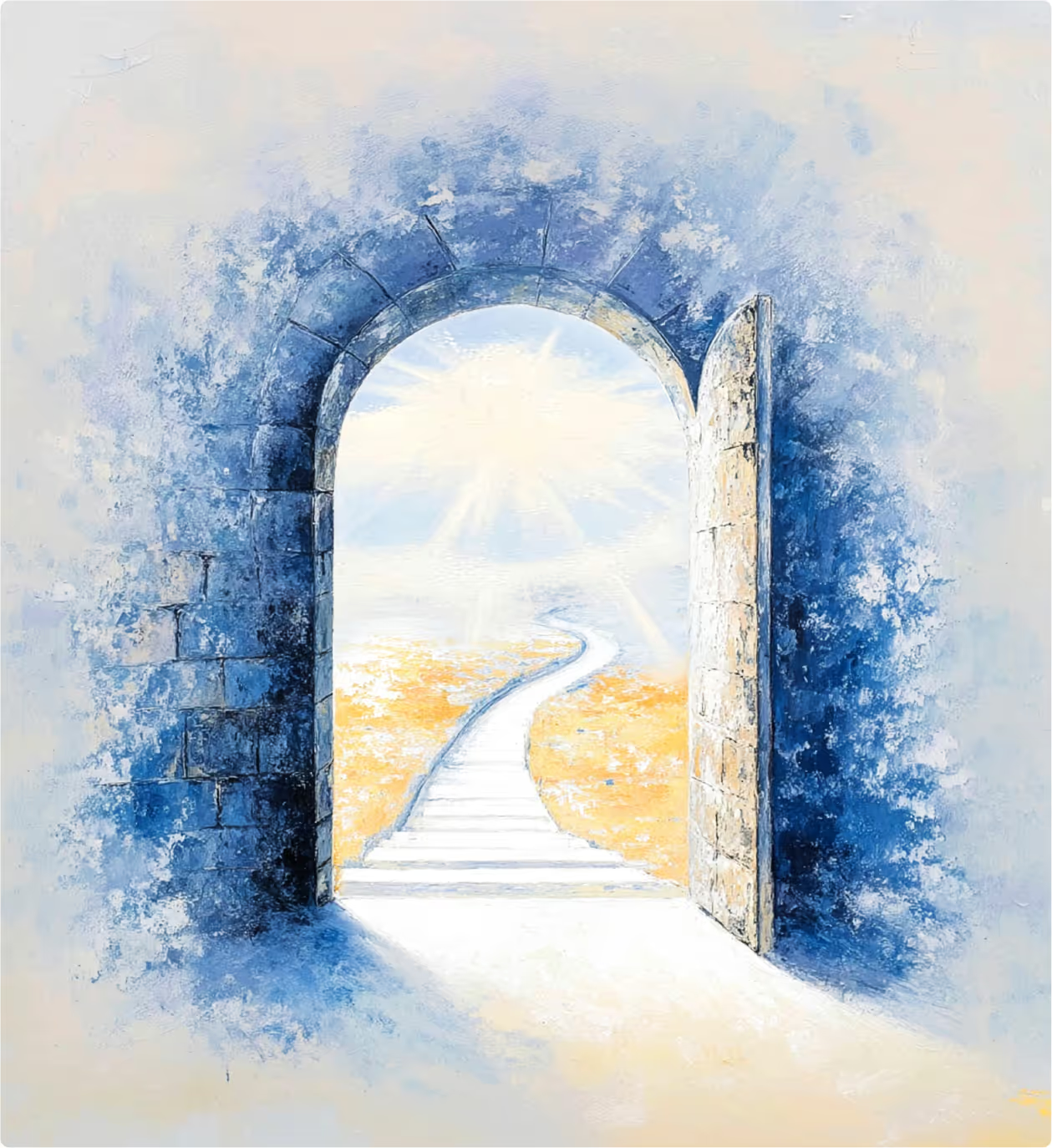
Torah isn’t here to make us perfect. It’s here to perfect US.
Your birthday is coming up, and your child wants to give you a special birthday card.
Which card would make you happier?
Option A: A glittery, 3D creation your child picked up at the drugstore. They walked in, asked a salesperson for the fanciest card in stock, sealed it in its glossy envelope, and gave it to you.
Option B: A slightly ragged card assembled from the art supplies lying around your house. Your child clearly worked for hours decorating every inch of it in their unique style and composing the arrhythmic poem inside.
You’d probably be impressed with the “perfect” drugstore card. But only the second one would bring tears to your eyes and special nachas to your heart. Because you don’t want perfection from your child. You want them to be themselves. To give from themselves. To do their best.
Last week, we stated an idea that might have surprised you – that bechirah doesn’t mean choosing the most correct option, but rather an option that resonates deeply with us. Yes, Hashem wants us to follow in His ways and do the right thing. But that’s not where it ends.
He’s also interested in us as individuals. In our personal development. He invested a fully unique personality within each of us for a reason. He doesn’t just want us to fill in the right bubbles on some standardized test. He wants us to express ourselves. To give to Him from ourselves.
At the time of the Exodus, we Jews were in a very low place. We’d reached the 49th level of impurity. Yet it was at that time that Hashem redeemed us. Why? Because He doesn’t just want us once we’ve reached greatness. He wants us at every stage. He wants to watch as we develop, as we become ourselves.
Rabi Akiva famously turned his life around after seeing a rock eroded by a thin stream of water. “If soft water can wear away a hard rock,” he declared, “Torah can certainly mold my heart.”
What was it about this water-rock encounter that impressed him so deeply?
A quote (l’havdil) from the famous Michelangelo might help us understand: “The sculpture is already complete within the marble block before I start my work. It is already there – I just have to chisel away the superfluous material.”
That perfect, beautiful version of ourselves? It’s already there inside us. We’re simply surrounded by a rough outer shell of earthly drives and imperfections. Torah isn’t there to break us and reform us into something different. It’s there to slowly smooth away our rough edges until our beauty emerges.
If we want this process to work properly – if we want to reveal our true inner beauty – we need to own our choices. Aside from trying our best throughout Yiddishkeit, which mitzvos do we want to really focus on? Are we particularly drawn to tefillah? Shabbos? Chesed?
And which direction do we want to take within each mitzvah? Will we daven slowly? Focus on humility or gratitude or reverence? Will we fill our Shabbos table with guests, or spend the day focused on family? Would we prefer chasadim like bikur cholim? Opening our home to lonely people? Volunteering our expertise?
Today, many people feel tremendous pressure in their Judaism. Why? Essentially, because they aren’t making their own choices – choices they identify with. Instead, they’re trying to conform to what they see as the objectively proper choices. They rely solely on the opinions they gather from greater people – and, in the process, forget that their thoughts and opinions are worth something too.
If we ourselves aren’t worth much until we hit benchmarks, until we accomplish, then we live constantly under heavy pressure to reach those benchmarks. But what if we could change our thinking? What if we could focus on the opportunities Torah gives us to develop ourselves?
We’d feel so much better about ourselves, so much less pressured, and so much more in sync with Hashem’s Will.
Let’s try to bear that in mind. Let’s stop this tunnel-vision focus on objective “perfect” goals. Let’s start owning and emphasizing our own development. Because Torah isn’t here to make millions of perfect little lookalike soldiers. It’s here to help each of us actualize ourselves.
More Articles in this Series
Subscribe to the weekly list
.avif)