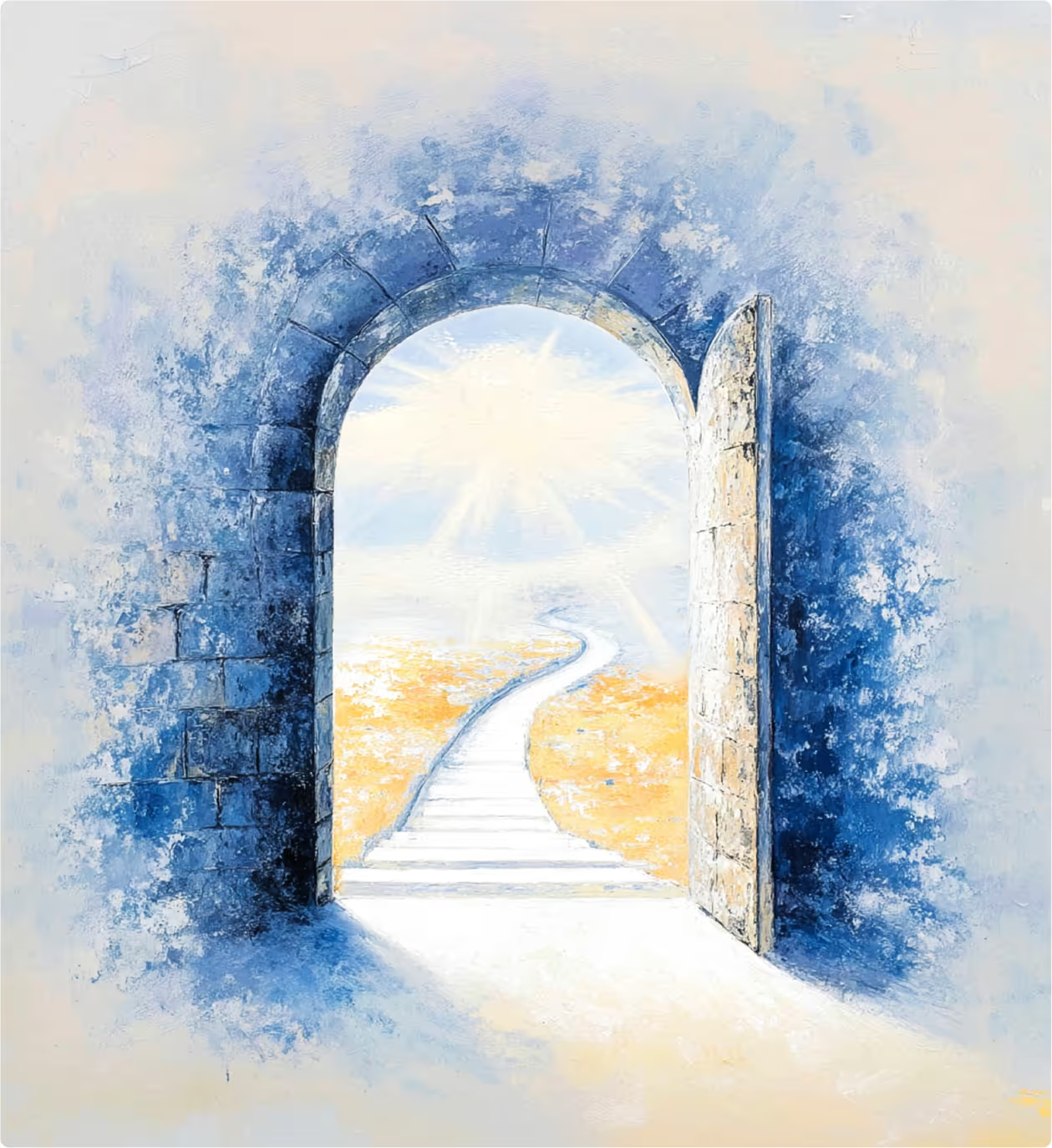
Why we have never given up – and never will.
Why don’t we Jews ever give up?
We’ve been through endless hardship, endless terror, millennia filled with attempts to wipe us out. Threats and enemies surround us. Our collective pain is fathomless – and many of us carry deep personal pain as well.
Why are we still proudly marching forward?
The archetypal example, of course, are Jews who survived the concentration camps. Or more recently, our hostages, finally emerging from 16 months of torture in Gaza. And what about those in the Parshiyos we're reading now – Jews who survived 80 years of concentration camps in Egypt. At the end of that time, they could have given up. But they didn’t. Why not?
Because of yediyah.
We’ve spoken about how yediyah strengthens our avodas Hashem – and ironically, our bechira – through our past. We’ve also explored how it activates our bechira toward avodah (serving Hashem) in the present.
What about the future? How does knowledge of Hashem’s absolute control of what’s to come empower our bechira to serve Him better?
To answer this question, let’s take a look at the story of the Exodus. When Hashem sent Moshe Rabbeinu to Egypt to free the Jewish people, Moshe had a question: “When the people ask me for Your name, what should I answer?”
Hashem replied with the name “Ekiyeh,” which means “I will be [with you].”
Hashem has many names that describe Him in the present. Why did He choose one that referred to Him in future tense?
Because one of our deepest foundations as Jews is our belief in Hashem’s control of the future. In the fact that everything happens for a reason. That it’s all part of His plan to bring us to ge’ulah – a state of redemption and happiness so much better and more perfect than anything we can imagine. A state of good triumphing over evil, and Hashem reigning supreme.
Ge’ulah might sound far away. But yediyah about our future doesn’t just mean belief in a happy ending. It means the conviction that every moment in our personal lives, in our communal experience – every single one is a crucial step in the process of bringing His plan to fruition.
Our pain isn’t for nothing. We’re not just here to try and avoid suffering because it wastes our precious time on this earth. No. We’re here for a purpose. We’re here to further the process of ge’ulah. Our existence, even the pain, serves a crucial role in that process.
There were Jews who died before the Exodus. We tend to see that as an unfortunate thing – what a waste, they were so close! But nothing about their lives or their deaths was a waste. Both played a role in the process of ge’ulah.
Rav Hutner ztz”l gave a very specific definition to the kefira (denial-of-G-d) we’ll be struggling with just before Moshiach comes: the denial of our power of choice. The belief that we’re stuck the way we’ve been programmed, and we can’t choose differently.
Looking at the world today, it isn’t hard to see this kefira at play. Society is kicking and screaming to be accepted just the way they are. Bad behavior is freely excused as a guilt-free reaction to childhood trauma. At the peak of civilization, humanity is becoming helpless.
But we Jews know we’re not helpless. We know every difficulty has a purpose. Every challenge, no matter how hopeless or devastating it seems, plays a part in furthering Hashem’s plan. Every moment of our lives carries positive, productive meaning, no matter the circumstances in which we experience it.
So in every moment, we have a choice. We have the bechira to lean into that purpose. To acknowledge Hashem’s process. To remember He’s moving us in the right direction.
As we ride this wild emotional rollercoaster between elation at our hostages’ release and the feelings triggered when we think about the deal we’ve entered – how do we avoid despair? And forget about us – what about the released hostages themselves? After the trauma they’ve endured, how can they hold strong and move forward with their lives?
Several of the hostages themselves have so movingly answered this question for us. Emunah. Faith. Belief in G-d’s promise to carry us on His shoulders forever.
We’re never stuck. If they can see it, we can too. There’s always room to find meaning, even inner peace, in the process we’re experiencing. Because it is a process. And it’s exactly how it should be. Exactly how it needs to be to get us to the unfathomable goodness Hashem is yearning to give us.
players in bringing this world to its purpose and that empowers us to live a life that’s aligned with the values of Moshiach
So as we are utilizing tefillah to build a world of yediyah for ourselves appreciate that it includes the end to which we are anxiously anticipating and which inspires us to living in accordance with
More Articles in this Series
Subscribe to the weekly list
.avif)