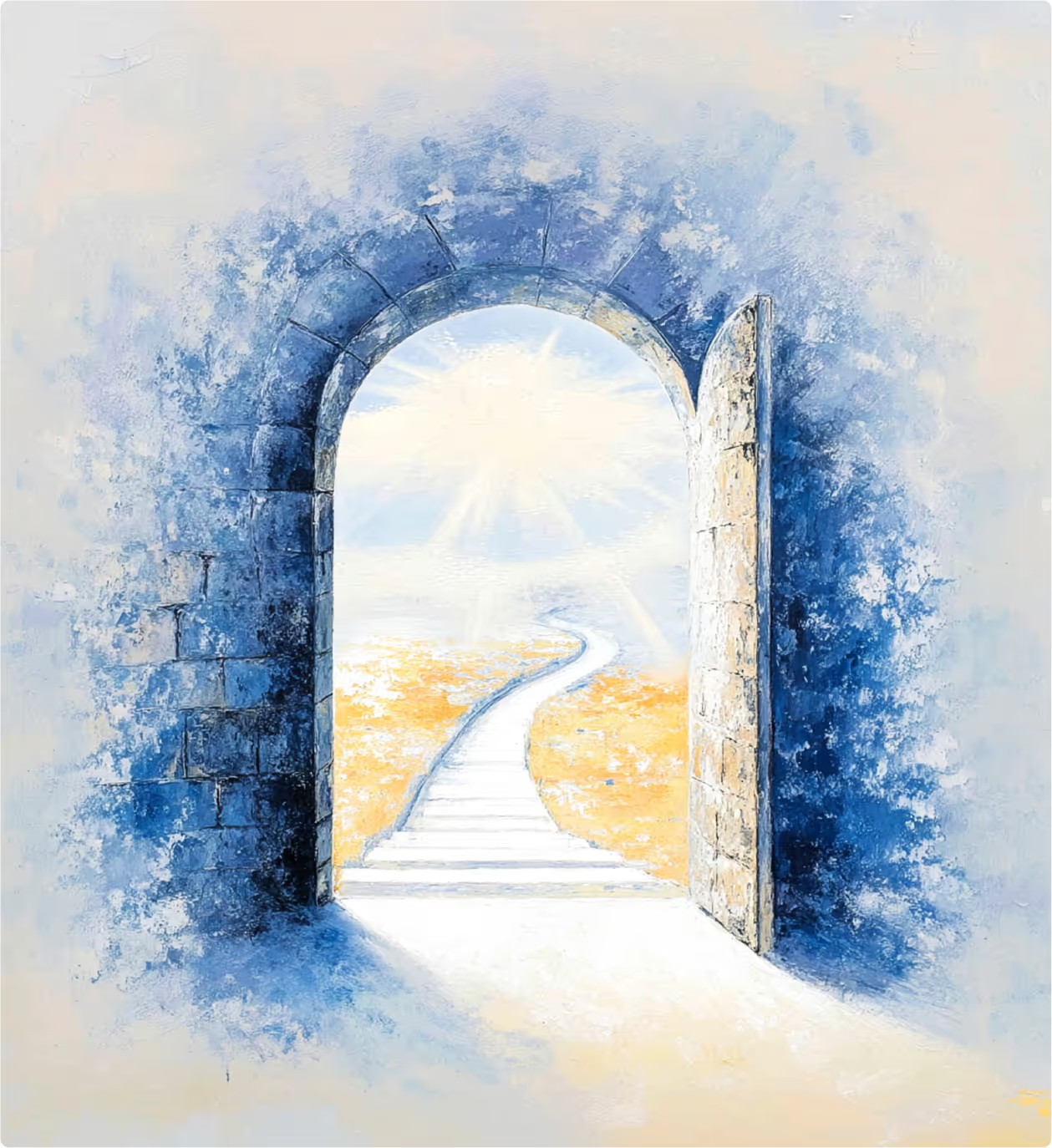
Anything is possible when, deep down, you’re limitless
What sets humans apart from other creations?
Free will, many will answer. Bechira.
That’s true. But there’s more to the answer. Including an element of yediyah.
We’ve been talking about the power of yediyah awareness to enhance our avodas Hashem. How it helps us rise above challenge, failure, and suffering and frees us to choose increased avodas Hashem no matter what.
Till now, we’ve been speaking about Hashem’s yediyah – His total, perfect control over everything that happens to us.
Before we step away from this topic, we need to take a look at the aspect of yediyah He invested in us, the humans He created in His image.
For the last two weeks, we’ve been working to understand why the Jewish people never give up. Why, despite every kind and degree of suffering, we hold our heads high, rebuild again and again, and stay ardently faithful to our Creator.
Now, we’re going to explore another insight into this wonder.
Bereishis tells us that on the 6th day of creation, “Hashem saw everything He had made, and it was tov mi’od – very good.”
Our Sages point out that “mi’od,” the Hebrew word for “very,” shares its three letters with the Hebrew word for man – “adam.” When Hashem uses the word “mi’od” here, they explain, He is referring to man.
Why? What about man is “mi’od?”
As part of a finite world, we humans assume we’re also finite. But Hashem actually infused one infinite element into the finite physical world He created – man’s infinite potential. Our limitless ability to actualize ourselves further and further and further.
Before the 9th Plague, Darkness, Pharoah told Moshe he could take his people out on their planned trip to serve G-d in the wilderness – but they’d need to leave their assets behind.
Oh no, Moshe responded. Not only will we take our assets, we’ll end up taking your livestock as well. Why? Because “we don’t know how we will serve Hashem when we get there.” (Shemos 10:26)
Rashi’s comment on Moshe’s words raises our eyebrows. “We don’t know how intense the avodah (work) will be because maybe Hashem will ask from us more than we have in our hands.”
But how can that be? How can Hashem, who knows our capabilities perfectly and only challenges us in ways we can handle, “ask from us more than what’s in our hands?”
Because we’re mi’od. We’re so much bigger, stronger, and more capable of greatness than we perceive ourselves to be. We might not “have it in our hands now” – the greatness Hashem is asking of us – but we have the capability to reach higher and access it.
Abstract and lofty as that might sound, we’ve all seen it in action. We’ve all met or heard of people who accessed unreal depths of strength and accomplished tremendous things. For instance, how do people who’ve spent 16 months chained and starved in a narrow underground tunnel emerge with a drive to rebuild their lives? And how did one of them, emaciated as the rest, find the inner strength to request that a fellow hostage in worse condition be released instead of him?
Because we humans are a lot bigger than we think we are. We’ve been imbued with “mi’odness,” a tinge of Hashem’s own limitlessness.
And why did Hashem give us this mi’odness, this manifestation of yediyah? So we could use our bechira. So we could appreciate our true essence.
So that, when Hashem does ask us for “more than what [we think] is in our hands,” we can choose to rise above the challenge – and actualize the potential that’s really always been ours.
More Articles in this Series
Subscribe to the weekly list
.avif)