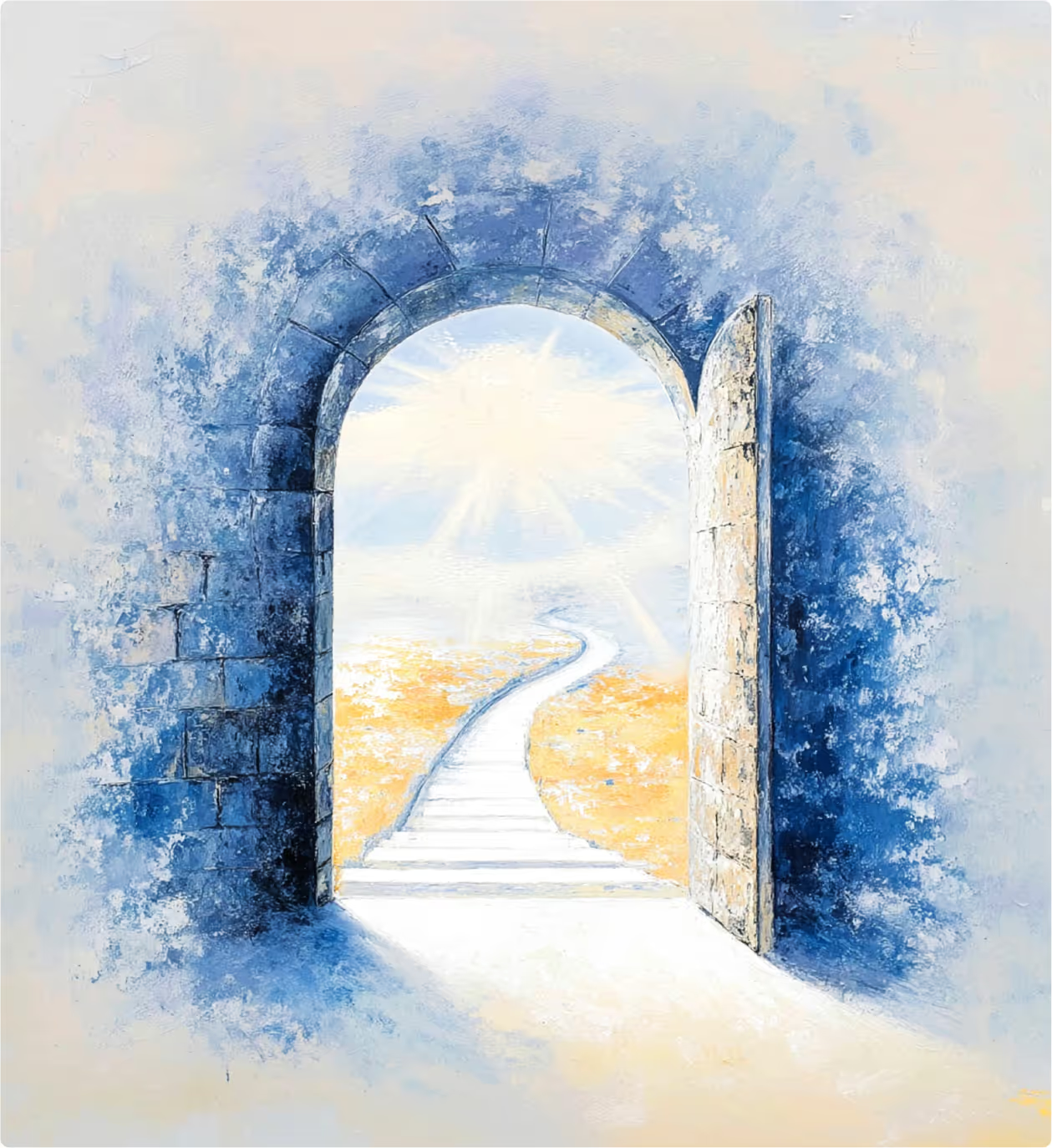
When you become a chesed spiri-preneur, who benefits most?
Here’s a question many of us probably haven’t thought of.
The Torah commands us to judge our fellow Jews favorably... but why?
Why judge the person at all? Is it really our job to assess someone else’s decision? Why haven’t we just been told to mind our own business?
In Mishlei, Shlomo Hamelech teaches us: “Tov ayin hu yivorach” – “He with a good eye will be blessed himself.”
Many people think that when they view others favorably, they’re doing someone else a favor. But Shlomo Hamelech makes it very clear that “Hu yivorach,” the judger himself gets the benefit.
How?
We absorb the influences of our environment. That’s how life works. Now, who determines what our environment contains?
To a large degree, ourselves.
The way we view others shapes the way we experience the world around us.
When we use an ayin ra’ah, a negative eye, we experience the world as meh. Mediocre. Limited. Mundane. Predictable. Lacking. And because the world is lacking, we don’t need to trouble ourselves to grow much either.
When we adopt an ayin tovah, however, the world becomes a place of depth. Possibility. Expansiveness. Potential for greatness. And because the world is a place of such greatness, we catch the “growing fever” around us. We start dreaming bigger, aiming bigger, as well.
Reb Levi Yitzchak of Berditchev was renowned for his penchant for seeing the good in others even in the most incriminating circumstances. One Shabbos, he walked by a Jew who was smoking.
“Did you forget that it’s Shabbos?” he asked gently.
“No,” answered the other man, continuing to smoke.
“Ah,” said Reb Levi Yitzchak, “You must have another valid reason.”
But the fellow refused to claim any excuse. He was just plain sinning, and he wasn’t afraid to make that known.
Hearing this, Reb Levi Yitzchak looked Heavenward and declared, “Master of the Universe, see the holiness of your people! They’d rather declare themselves sinners than utter a lie!”
Another day, Reb Levi Yitzchak noted a Jew greasing the wheels of his buggy while davening Shacharis, wrapped in tallis and tefillin. Instead of rebuking the man, Reb Levi Yitzchak turned to Hashem and cried, “Hashem, look at how holy your nation is! They even grease the wheels of their buggies with tallis and tefillin on!”
Reb Levi Yitzchak was no fool. He wasn’t naïve. He wasn’t eccentric. He was a remarkable tzaddik and Torah scholar.
He was simply the product of tremendous self-work in the area of ayin tovah. He wanted to live in a world of greatness. He wanted that possibility, depth, and expansiveness to be his.
The Torah wants the same thing for us. That’s why it instructs us to judge others favorably. Work to see the good. Push yourself to live in a brighter, wider, greater world.
We’ve spent the past few months becoming spiri-preneurs in chesed. Instead of viewing chesed simply as our response to someone’s lacks, we’ve learned to use it as a means to light up others’ lives, to help them access more goodness – and more greatness.
When we do for others, in thought or in action, we can do so much more than fill a need. We can build worlds. Bring people new life.
And when we do – when we step out of the world of mediocrity and into the world of greatness – the one who benefits most is truly “hu.” Ourselves.
Do we want a life of smallness, or of greatness? Do we want to live that easy life of “meh,” or climb up into a world of possibility and beauty?
Chesed spiri-preneurship isn’t easy. But, as Shlomo Hamelech promises, there’s tremendous bracha waiting for us if we take the opportunity.
More Articles in this Series
Subscribe to the weekly list
.avif)